Yes: failure location and predictive maintenance are core outputs
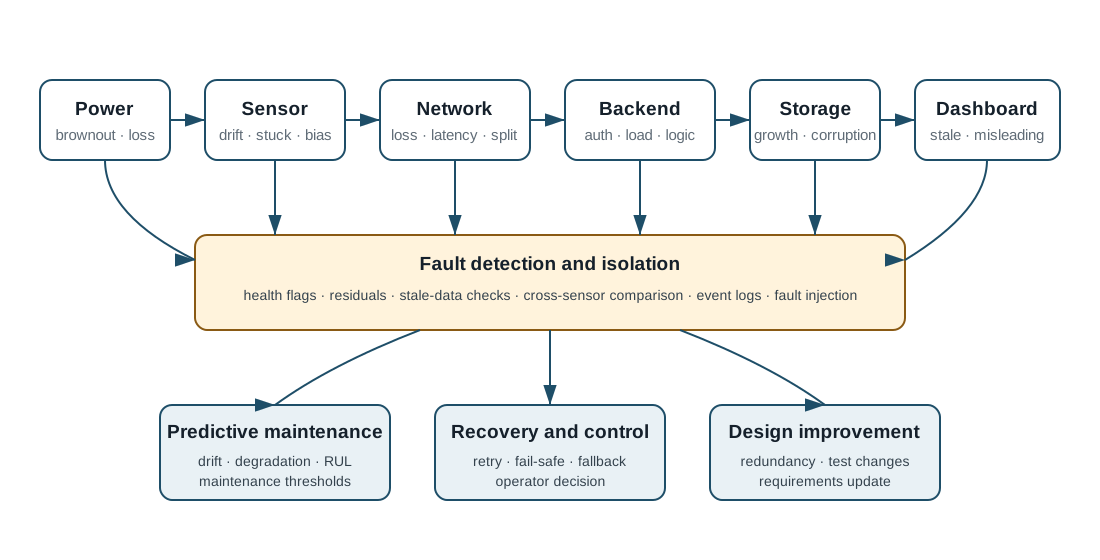
The lab will not stop at nominal performance. It will model failure initiation, propagation, detectability, isolation, recovery, degradation, and remaining useful life. The goal is to answer four questions:
- What can fail?
- Where does the failure originate and how does it propagate?
- What evidence reveals the failure early?
- What maintenance or design action prevents mission impact?
Simulation workflow
Engineering question -> Boundary -> Assumptions -> Model -> Baseline
-> Verification -> Validation -> Fault injection -> Sensitivity
-> Results -> Decision -> Physical test
Complete simulation coverage
| Domain | What it reveals | Initial tools |
|---|---|---|
| Sensor and measurement | Noise, drift, bias, calibration, sampling, observability, false alarms, missed events. | Python, Jupyter |
| Failure modes and propagation | FMEA, fault trees, dependency chains, common-cause failures, mission impact. | Python, diagrams, Capella later |
| Reliability and availability | MTBF/MTTR scenarios, redundancy value, repair policies, Monte Carlo availability. | Python, reliability libraries |
| Predictive maintenance | Anomaly detection, drift, degradation trends, remaining-useful-life estimates, maintenance thresholds. | Python, time-series models |
| Power and energy | Battery life, duty cycles, brownouts, power budgets, backup capacity. | Python, LTspice, measurement |
| Thermal and airflow | Self-heating, enclosure bias, cooling, vent and sensor placement. | Fusion CAD, SimScale/OpenFOAM |
| Structural and vibration | Mounting loads, enclosure strength, resonance, fatigue, shock. | Fusion/ANSYS later |
| Controls | Stability, overshoot, oscillation, actuator limits, disturbance rejection, safe states. | Python control, Simulink later |
| Communications and networks | Packet loss, latency, coverage, congestion, partitions, retry behavior, store-and-forward. | Python, network emulation |
| Software and queueing | API load, database growth, bottlenecks, concurrency, backpressure, recovery. | Load tests, Python |
| Cyber-resilience | Authentication failure, compromised nodes, denial of service, trust boundaries, fail-safe behavior. | Threat models, controlled tests |
| Human and operational | Alarm fatigue, maintenance workload, response delays, decision thresholds, handoff risk. | Discrete-event models |
| Infrastructure and resources | Supply disruption, energy/water dependencies, redundancy, cascading failures, recovery priorities. | Python, system dynamics, GIS later |
| Cost and decision analysis | Redundancy versus cost, lifecycle cost, maintenance timing, investment under uncertainty. | Python, Monte Carlo |
| Digital twin and co-simulation | Live state estimation, model-to-asset comparison, failure prediction, control optimization. | Python, Grafana, MQTT |
| Robotics and autonomy | Robot dynamics, perception, navigation, manipulation, reinforcement learning, synthetic data, human-robot interaction, and autonomous fault recovery. | ROS 2, Isaac Sim, Isaac Lab, Gazebo |
| Biomedical and human systems | Anatomical geometry, musculoskeletal loading, soft-tissue mechanics, cardiovascular flow, physiology, medical-device interaction, and surgical simulation. | 3D Slicer, OpenSim, SOFA, SimVascular, FEBio, OpenCOR |
Program sequence
- Sampling interval and alert latency.
- Power budget and duty-cycle model.
- Sensor drift, calibration, and fault-detection model.
- Failure-mode map, fault injection, and diagnostic coverage.
- Reliability/availability Monte Carlo model.
- Enclosure airflow and thermal-bias study.
- Workshop/greenhouse control model.
- Predictive-maintenance pipeline using accumulated telemetry.
- Network reliability and offline-recovery model.
- Digital twin linked to the physical controller.
- Robotics and autonomy track: mobile inspection, manipulation, synthetic sensors, and fault recovery.
- Biomedical and human-systems track: anatomy, biomechanics, physiology, and medical-device simulation.
Validation rule: A simulation result will never be presented as physical truth until it is compared against measurements, a benchmark, an analytical solution, or another credible source.