Engineering question
How frequently should an environmental node sample and report data to detect meaningful excursions quickly without creating unnecessary noise, network traffic, or storage demand?
Scope
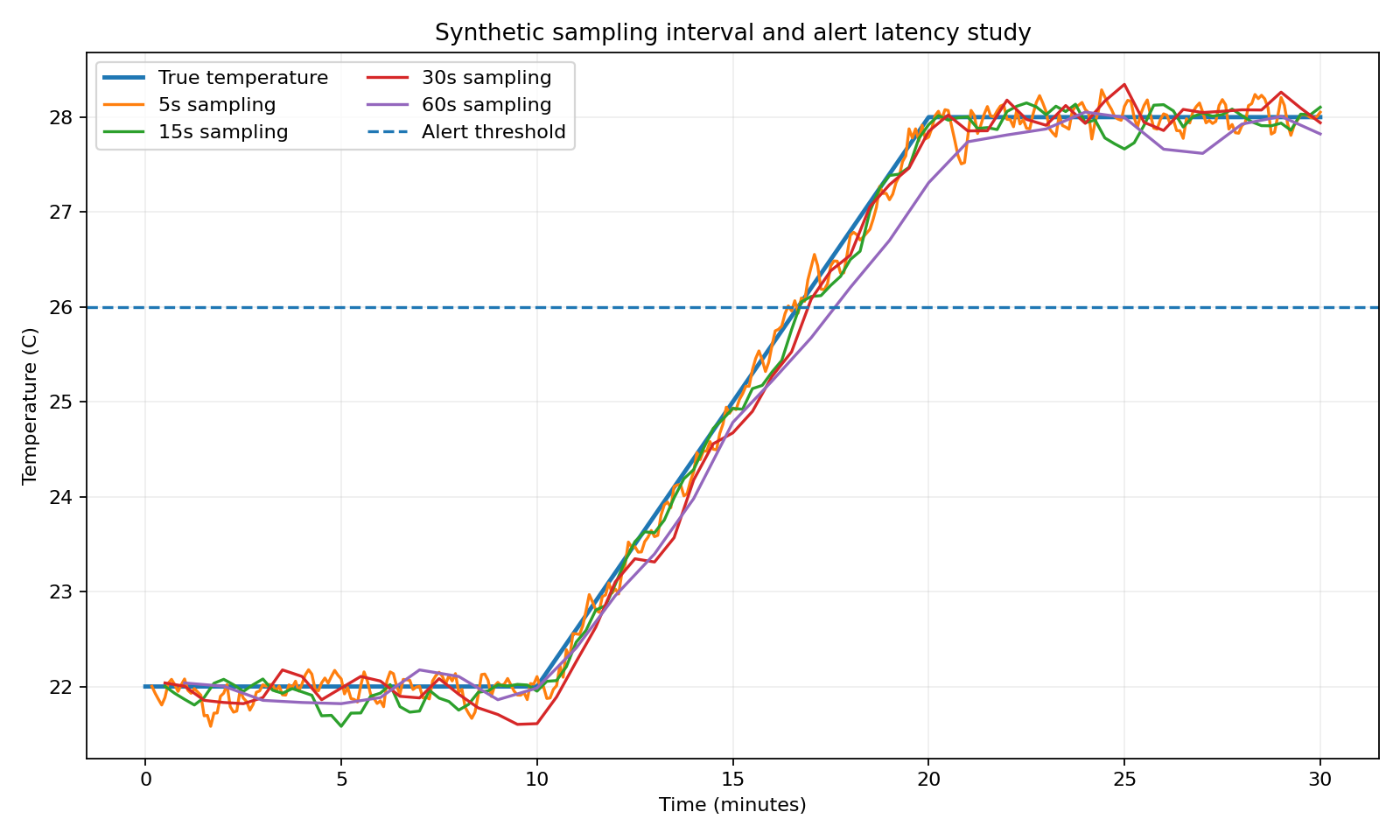
This is a synthetic study, not a claim about measured DHT11 performance. It models a generic low-cost temperature sensor observing a gradual temperature excursion with measurement noise.
Model
- Baseline temperature: 22 C.
- Temperature excursion begins at minute 10 and rises to 28 C.
- Alert threshold: 26 C.
- Sampling intervals compared: 5, 15, 30, and 60 seconds.
- Detection uses raw samples and a short moving average.
Initial result
Shorter intervals reduce alert delay but increase transmissions and stored records. Filtering suppresses noise but adds additional delay. The correct interval is therefore an engineering tradeoff tied to the speed of the physical process and the consequence of late detection.
| Sampling interval | Synthetic alert delay | Relative records/day |
|---|---|---|
| 5 seconds | Lowest | 17,280 |
| 15 seconds | Low | 5,760 |
| 30 seconds | Moderate | 2,880 |
| 60 seconds | Highest | 1,440 |
Decision implication
For slowly changing room conditions, a 15-30 second local sampling interval with less frequent batched reporting may provide a better balance than making sampling and transmission frequencies identical. Faster safety-critical processes would require a different design.
Next validation
- Replay real sensor data from the existing platform.
- Measure actual network and database load.
- Compare filtering methods and threshold hysteresis.
- Test missed data, stale data, and sensor-stuck failure modes.